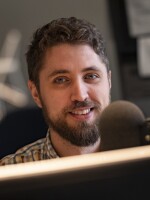
If you keep up with the careers of Philadelphia-born musicians, you are probably aware of Germantown native pianist Leon Bates, who died last year after a long struggle with Parkinson’s disease. He went to Settlement Music School as a child, studied at Temple’s Boyer College of Music and Dance, and had a very active career, performing 100 concerts a year, including several with The Philadelphia Orchestra and for the Philadelphia Chamber Music Society. He also hosted Notes on Philadelphia, one of WRTI’s first locally-created specialty programs after its adoption of classical music programming in 1997.
One of Bates’ most prominent students is Dynasty Battles, who studied with Bates for 10 years and shares his teacher’s Germantown roots. Battles also has prominent nationwide performances under his belt, including his own PCMS recital and a concert alongside fellow Philadelphia pianist Michelle Cann with the Los Angeles Philharmonic. His programs regularly feature improvisation, which connects the pieces on his programs to each other, and to the world outside of classical music. Battles contributed to his teacher’s obituary in the Philadelphia Inquirer, noting that “Mr. Bates showed him how every concert program could be ‘a journey’ and that rich, ‘radical’ elements in music were already there to be found.”
On Saturday, Battles will perform a solo concert in tribute to Bates, featuring Beethoven and Scriabin sonatas, a set of Chick Corea pieces, and selections yet to be named. He joined me for a conversation about his performance practice, the Germantown neighborhood he shared with his teacher, and his mission to forge connections between the music’s past and present.
Could you talk a bit about your background as well as the kind of work and performance that you do, kind of your programming philosophy?
Well, the one thing I like to do is bring different styles together in one concert. And it's part of my way of [reminding] people that we have more in common than we do uncommon. One of the things that prompted me to pursue piano was that my sister was taking piano lessons. She used to teach me informally when I was a kid. But there were a lot of people I was surrounded by, whether it was classmates or my teachers, who played piano. It just seemed like it was a normal thing to do on the side. So I figured that I would do the same, especially since it made me feel good to hear that instrument.

Not everybody has that kind of environment to grow up around, right? So you want to have people be able to just see that music happens.
Absolutely. And it's me bringing my authentic self to the stage. What I grew up around — classical, jazz, gospel, rock music, you name it. So that's what's reflected in the mission statement and also in my performances as well.
I want to talk about one part of your mission statement: “At its core, my work is about renewal — honoring the depth of the classical tradition while activating it in the present.” Could you talk more about that?
I do believe that we do have a lot in common with the past, and the past has a lot in common with the present. I'll use Wayne Shorter, for example, in instrumentation. If you look at the instrumentation that Wayne Shorter uses in his opera Iphigenia, what may classify it as classical and not jazz is the instrumentation — the use of the strings, for example. But if you listen to the harmonies, the harmonization that he uses and that composition that he did with esperanza spalding, you will find a lot of common ground with jazz.
Now, your upcoming program is in honor of your teacher, Leon Bates. Could you talk about your relationship with him?
Mr. Leon Bates helped me to bring more of my authentic self to the stage. He was a strong advocate of leaning into my thoughts and my feelings and putting it all on the stage, all into the music, because he made me realize that the composers themselves put their lives and thoughts and feelings into the music.
I also understand that this is as much a concert for Philadelphia — and zooming in further, for Germantown, because you're doing this at the First Presbyterian Church.
Yes, yes. The Germantown neighborhood was a place that Leon Bates once called home. It's where he went to school, where he took lessons at the Settlement Music School that's on Germantown Avenue, and also where he grew up. So I thought it would be very fitting to bring it home.

Did you have a sort of neighborhood connection with Mr. Bates when you worked with him?
I had a neighborhood connection, in the sense of him and his stories that he would bring up. So as he would bring up landmarks, it was easy for me to envision the background of whatever story he's telling me, because I've seen those landmarks, I've seen those places. In some cases I was around at the same time, during some of these events that he would share with me. One thing that makes me think of was when Mr. Bates used to perform at different schools for children, to pass on how accessible music is and how enjoyable it could be. Sometimes he would play children's songs and then classical songs. You see the differentiation there with how he would bring the past and the present together.
How did you come up with the program for this upcoming concert?
Well, three different compartments — that would be my personal studies with him, the common ground that we have with repertoire, also the various layers with Mr. Bates. It will reflect a personal thank you to Mr. Bates from me personally. I have the Tempest Sonata by Beethoven. I'm also playing Scriabin’s Piano Sonata No. 4. In addition to that, I'll be playing a few selections of Chick Corea’s Children's Songs.
When you do a recital, do you talk about the music from the stage, or do you leave it to the program for people to read?
I absolutely love discussing the compositions that I am playing to the people that are in the audience. That way they can find themselves in the music and understand it a lot more. In between some of the pieces that I'll be playing, I will be injecting stories about Mr. Bates, stories about Mr. Bates and myself, for example. I look forward to doing it.